
Reimagining the Capital at a Historic Crossroads
For thousands of years, Afghanistan has stood at the crossroads of civilizations. Today, Kabul finds itself at another historic turning point. The Kabul City Urban Design Framework is not simply another master plan—it is a strategic vision that seeks to transform Kabul into a green, inclusive, resilient, and economically dynamic capital for the 21st century.
Prepared under the special direction and close supervision of former President Mohammad Ashraf Ghani, and developed by the Ministry of Urban Development and Housing in collaboration with Sasaki, this framework represents a shift in how Kabul’s future is imagined. To understand its significance, we must first examine Kabul’s history, geography, urban morphology, and previous planning efforts.
Kabul: A City of Empires and Trade
Kabul has never been an isolated city. Throughout history, it has been shaped by:
- The Achaemenid Empire
- The campaigns of Alexander the Great
- The Mughal Empire
- The Durrani Empire
- The trade networks of the Silk Road
For centuries, Kabul functioned as a commercial and cultural hub linking Central Asia, South Asia, and the Middle East. This historic position gave Kabul a cosmopolitan identity.
Importantly, the Urban Design Framework does not attempt to invent a new Kabul. Instead, it seeks to reconnect the city with its historic role—one that was disrupted by poorly conceived urban projects, four decades of war, and fragmented development.
Geography: The Foundation of Urban Form
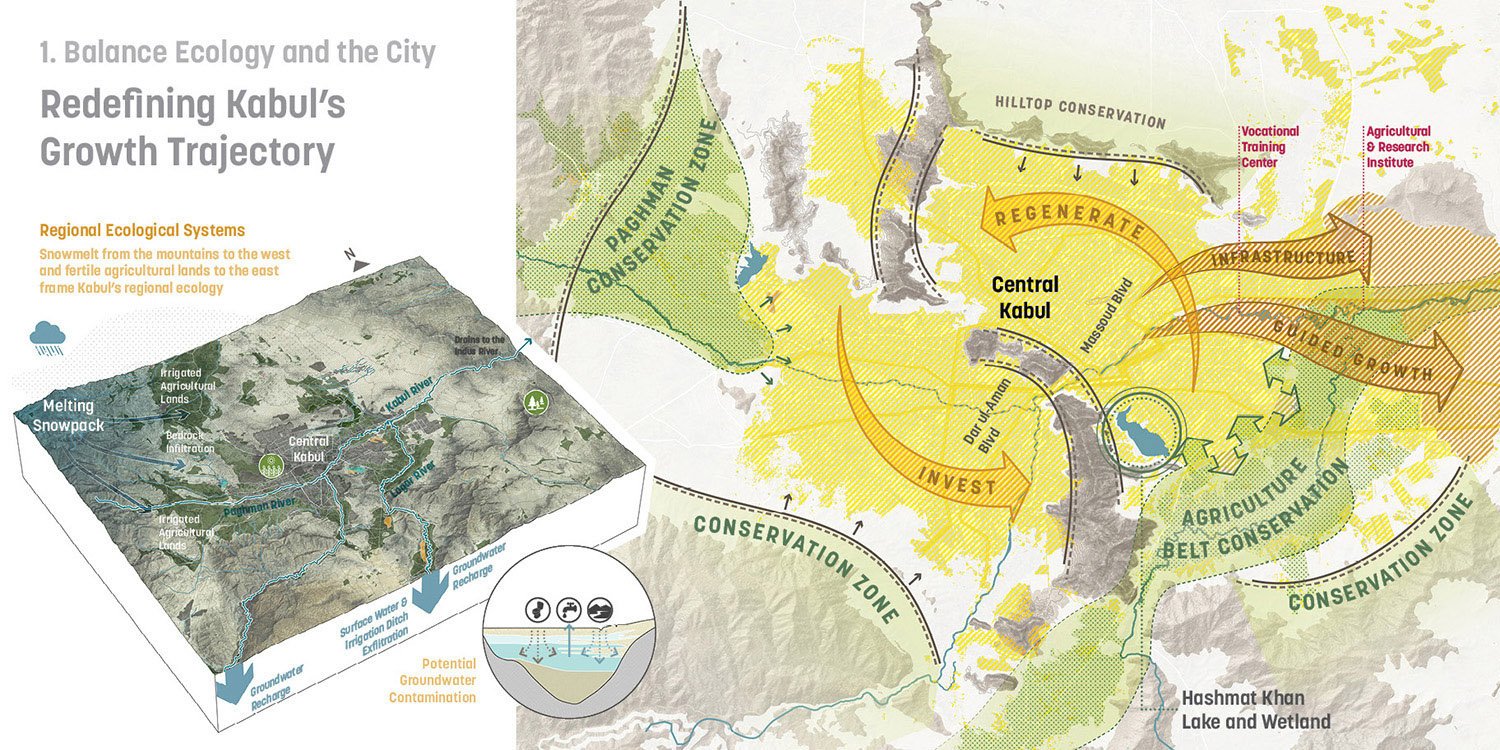
Kabul’s urban structure is deeply intertwined with its natural environment. The city is shaped by:
- Surrounding mountains
- The Kabul River
- Agricultural green belts
- Snow-fed hydrological systems
Seasonal snowmelt from the mountains feeds rivers and recharges groundwater. However, rapid and informal urban expansion has threatened:
- Groundwater resources
- Surface water quality
- Agricultural lands
- Ecological balance
The framework recognizes that Kabul’s future depends on ecological restoration. Without environmental resilience, sustainable urban growth is impossible.
Urban Structure and Morphology
Kabul has a distinctive urban form:
- The historic old city along the Kabul River
- A traditional administrative and civic center
- Radial roads extending outward from the core
- Soviet-era microrayons (planned housing blocks)
- Expansive informal settlements on surrounding hillsides
Nearly two-thirds of Kabul has developed informally. Rather than proposing demolition, the framework promotes integration and upgrading of these areas. This is one of its most progressive and realistic elements, as it directly impacts the lives of the majority of residents.
Previous Planning Efforts in Kabul
Kabul has experienced multiple planning waves:
Early 20th Century Modernization: Urban reforms during the reign of Amanullah Khan introduced new roads, civic institutions, and the Darulaman expansion corridor.
1978 Soviet Master Plan: Introduced zoning, microrayons, and organized residential blocks. However, it assumed controlled population growth. Decades of war and migration invalidated those assumptions.
2011 JICA Master Plan: Developed with support from Japan International Cooperation Agency (JICA), it proposed:
- A ring road
- Agricultural belt preservation
- Water-based development strategies
- Kabul New City
The Urban Design Framework differs significantly. It prioritizes:
- Strengthening the existing city
- Corridor-based regeneration
- Urban quality improvements
- Integration of informal areas
This represents a strategic shift—from outward expansion to internal consolidation and revitalization.
Why a New Framework Was Necessary
Kabul faces major challenges:
- Rapid population growth
- Informal and unplanned expansion
- Infrastructure deficits
- Environmental degradation
- Limited mobility and safety for women
- Weak institutional coordination
A comprehensive and integrated urban design framework serves as a bridge between high-level policy and implementable projects. It coordinates land use, transport, infrastructure, and environmental systems within a long-term, three-dimensional vision.
Structure of the Framework: Six Complementary Volumes
The Kabul City Urban Design Framework is not a single standalone document. It is composed of six interrelated volumes:
- Executive Summary
- Citywide Framework
- Dar ul-Aman Corridor District
- Massoud Corridor District
- Infrastructure Systems
- Implementation Strategies
Each volume addresses Kabul’s development at different scales and levels of detail. The Citywide Framework establishes overarching metropolitan strategies, which are then translated into more specific spatial visions within the corridor-scale documents—particularly for Dar ul-Aman and Massoud.
Critical themes such as infrastructure systems and implementation mechanisms are integrated throughout the framework but are also given focused attention in dedicated volumes. This layered structure ensures alignment between vision, spatial design, infrastructure investment, and governance.
Importantly, the framework is intended to function as a living guidance document. Future plans and design proposals are expected to further elaborate and operationalize the ideas presented here. It establishes direction and strategy—not a rigid final blueprint.
Vision: A Green, Civilized, and Inclusive Capital
The framework proposes three core identities for Kabul:
A Green City:
- Restoration of the Kabul River
- Public parks and open space networks
- Hilltop trail systems
- Tree planting and green belts
- Agricultural land preservation
This reflects principles of landscape urbanism and ecological planning.
A Dignified Capital:
- Major urban corridors
- Connected public and green spaces
- Revitalized city center
- Strengthened civic and administrative institutions
It seeks to restore Kabul’s national stature and symbolic presence as a capital city.
An Inclusive City:
Urban design can foster social equity through:
- Safe public transportation for women
- Well-lit transit stations
- Distributed higher education institutions
- Balanced service provision across districts
Inclusivity is embedded in spatial planning.
Transport and Infrastructure as the Backbone
Infrastructure is treated as the backbone of transformation. The framework proposes:
- Public transport corridors
- Modern water supply networks
- Wastewater treatment systems
- Waste-to-energy solutions
- Irrigation systems
- Sustainable energy production
This systematic planning approach recognizes that without infrastructure, urban visions remain theoretical.
Higher Education as a Development Engine
The framework proposes a distributed network of universities—not only as educational institutions, but as:
- Economic engines
- Innovation hubs
- Catalysts for urban regeneration
For Kabul’s young population, this represents a long-term development strategy linking education to economic growth.
Legal and Institutional Foundation
Parts of the framework were prepared in accordance with Article 5 of Cabinet Decree 14 of the Islamic Republic of Afghanistan (dated 14/04/1394), providing it with formal legal grounding.
The responsibility for advancing and implementing the framework was assigned to:
- The Ministry of Urban Development and Housing (MUDH)
- Kabul Municipality
- The Central Independent Development Authority (CRIDA)
- Other relevant governmental agencies
With its official endorsement, the Kabul City Urban Design Framework was declared legally effective. Any urban plans or development documents contradicting this framework were considered invalid for development control purposes.
This provision aimed to prevent fragmented planning, strengthen regulatory authority, and ensure institutional alignment behind a unified urban vision.
Political Endorsement and Implementation Challenges
The framework received formal approval from Mohammad Ashraf Ghani, giving it legal legitimacy.
However, implementation depends on:
- Political stability
- Institutional capacity
- Sustainable funding
- Administrative coordination
- Technical expertise
A vision succeeds only when it is implemented effectively.
Professional Evaluation
From a professional urban design perspective, the framework is strong because it:
- Integrates ecology with urban design
- Recognizes and upgrades informal settlements
- Incorporates gender inclusion
- Prioritizes infrastructure
- Focuses on internal strengthening rather than unchecked expansion
- Links education with economic development
- Establishes coordinated governance and implementation mechanisms
Yet, challenges remain—especially in governance, funding, technical capacity, and long-term stability.
Conclusion: Beyond Physical Transformation
Kabul’s transformation is not merely a physical issue. It is ecological, social, economic, and political.
The Kabul City Urban Design Framework establishes:
- A strategic metropolitan vision
- Corridor-scale urban design precision
- Infrastructure-led development logic
- Implementation pathways
- Legal authority and administrative direction
It envisions a:
- Green capital
- Connected city
- Inclusive society
- Resilient ecological system
Its success ultimately depends on sustained commitment and strong institutions. Kabul stands once again at a crossroads—its future will be determined not by vision alone, but by action.