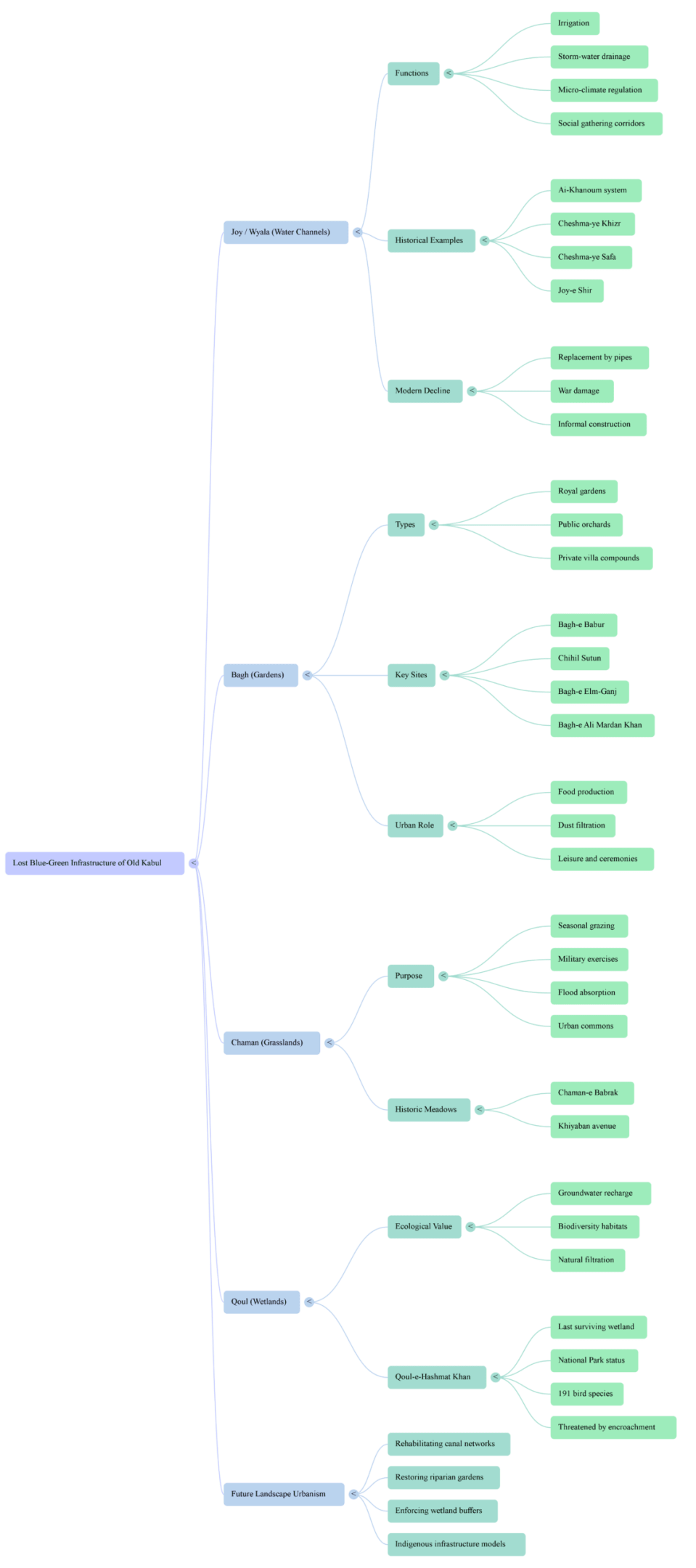

For centuries, the vanished infrastructures of Kabul, including Joy channels, gardens, grasslands, and wetlands, shaped the city’s urban life and ecological networks. These elements were not decorative luxuries; they constituted the city’s environmental infrastructure—systems that moderated climate, sustained agriculture, structured public life, and supported biodiversity.
In the historic city of Kabul, four fundamental landscape–infrastructure types shaped everyday urban life:
- Joy / Wyala – traditional water channels
- Bagh – gardens
- Chaman – grasslands and commons
- Qoul – wetlands
Today, nearly all of these systems have disappeared. Among the many wetlands that once surrounded Kabul, only Qoul-e-Hashmat Khan survives—severely threatened, encroached upon, and fragmented.
This essay examines these four lost infrastructures and places particular emphasis on the historical and ecological significance of Hashmat Khan Wetland.
1_Joy (Wyala): Kabul’s Forgotten Hydraulic Network
Before pipes, pumps, and concrete culverts, Kabul relied on an intricate network of open water channels known as Joy in Dari and Wyala in Pashto.
These channels diverted water from rivers—especially the Kabul and Logar Rivers—into neighborhoods, orchards, agricultural fields, mosques, and gardens. They functioned simultaneously as:
- irrigation systems
- storm-water drainage
- micro-climate regulators
- edges of public space
- social gathering corridors
Running along streets and property boundaries, Joy networks cooled the air through evaporation, supported tree canopies, and structured settlement patterns. The morphology of old Kabul—its houses, bazaars, and gardens—clustered around these channels.
With modernization, war damage, informal construction, and the replacement of open systems by underground pipes, most Joy disappeared—along with the cooling and ecological services they once provided.
Springs and Water Systems in Afghan Urban History
Water was considered the most fundamental prerequisite for city building. Historically, cities were often founded along rivers, and Afghanistan possessed a long tradition of water management. Organized irrigation systems—canals and Joy—have existed for thousands of years.
In the Greco-Bactrian city of Ai-Khanoum, a fully engineered internal water system operated. Along the Helmand River, hundreds of fortresses and settlements were connected to canal networks. Urban expansion was made possible through these Joy and Wyala.
In Kabul, Cheshma-ye Khizr, Cheshma-ye Safa, and another spring supplied continuous water to the gardens and grasslands of Bala Hissar. Babur intended these springs to irrigate gardens. During the reign of Amir Sher Ali Khan, springs served both public recreation and garden irrigation.
Water channels were central to supplying the city and sustaining vegetation, gardens, and meadows. In Babur’s period, Kabul’s canal systems played a decisive role in garden construction. In Bala Hissar, canals were also used for water storage and food production. Across Kabul and other Afghan cities, gardens depended entirely on hydraulic systems.
2_Bagh: The Garden as Urban Infrastructure
The Bagh—garden—was a defining element of Kabul’s cultural landscape. Royal gardens, public orchards, riverside promenades, and villa compounds once punctuated the city and its outskirts.
These landscapes served as:
- productive zones for fruit and vegetables
- leisure spaces
- ceremonial grounds
- ecological buffers along waterways
Bagh-e Babur, Chihil Sutun, Bala Bagh, and countless lesser-known orchards formed a green network that moderated heat, filtered dust, and connected urban life with agriculture.
Today, many historic gardens have shrunk or become isolated by dense construction. Others have vanished altogether, replaced by housing blocks and roads.
Historic Gardens and Their Locations
All Afghan historic cities possessed three types of gardens:
- royal gardens
- state gardens
- private gardens belonging to wealthy merchants and officials
As populations increased, gardens frequently expanded beyond city walls. The tradition of garden building persisted across all periods.
Babur, Ahmad Shah Baba, Timur Shah, Zaman Shah, and other rulers constructed numerous gardens. Gardens were regarded as a fundamental component of urban civilization.
Bagh-e Babur remained historically significant through the reigns of Amir Abdul Rahman Khan and Amir Amanullah Khan and was later targeted for restoration.
Chihil Sutun Garden was rehabilitated with assistance from the Aga Khan Trust.
Bagh-e Umumi, near Timur Shah’s mausoleum, functioned as a public gathering and recreation ground.
Bagh-e Elm-Ganj, located between Deh-Afghanān and Deh-Mazang in the Machine-Khana area, was planned as a cultural and commercial center with four to five large halls for assemblies. The Machine-Khana building and massive walls were under renovation, while gardens were planned along Joy-e Shir and Mount Asmai.
Bagh-e Ali Mardan Khan, near today’s Maiwand Road, included caravanserais later integrated into garden schemes.
Bagh-e Shah-Do-Shamshera incorporated historic mosques and caravanserais. According to Mahmud Tarzi’s memoirs, Kabul residents gathered there weekly for picnics and tea ceremonies; the Russian ambassador was once received there beneath Mount Asmai. To one side stood the monopolies building, to the other the Machine-Khana complex and Najat School (later Amaniya), until it burned down. This entire stretch—from Shah-Do-Shamshera Bridge to Artan Bridge—formed part of Elm-Ganj Garden. Amir Abdul Rahman later constructed Machine-Khana facilities here, documented in photographs and British engineers’ accounts.
Gardens from Babur to the Amirs
In Babur’s era, at least seven major gardens existed in Kabul. A vast avenue known as Khiyaban extended from Bala Hissar to Bibi-Mahru, where horse races were held amid surrounding gardens.
Ali Mardan Khan developed gardens flanking two long bazaars—Charchata and Shor Bazaar—linking residential quarters with green landscapes.
Under Timur Shah, Kabul’s streets and gardens followed Ahmad Shah Baba’s organizational principles. Zaman Shah continued Babur’s legacy.
During Amir Sher Ali Khan’s reign, Sherpur district featured extensive gardens, while Cheshma-ye Khizr and Cheshma-ye Safa became leisure destinations.
In Bala Hissar, Babur established gardens supplied by perennial springs. Later rulers expanded these chahar-bagh layouts. Amir Dost Mohammad Khan restored sections and designated some areas for parks and archaeology.
Gardens were integral to urban life: attached to markets and major streets, serving residential, recreational, and aesthetic roles. British invasions destroyed parts of Bala Hissar and its gardens.
Under Amir Habibullah Khan and Amir Amanullah Khan, some gardens were subdivided or allocated to embassies.
3_Chaman: Grasslands and Urban Commons
The Chaman—open meadow or grassland—functioned as Kabul’s commons.
These flexible landscapes supported:
- seasonal grazing
- festivals and assemblies
- military exercises
- recreation
- temporary cultivation
Chaman areas lay between city and countryside, absorbing floodwaters, cooling the microclimate, and providing breathing space within dense urban fabric.
Kabul once possessed water basins and reservoirs that enhanced the city’s beauty, including Qoul-e-Hashmat Khan, Chaman-e Babrak, and areas surrounding today’s airport—raising the question of whether these landscapes might ever be restored to revive Kabul’s former appearance.
Livestock production supplied urban food needs; therefore cities required extensive surrounding grasslands and pastures. These meadows were vital for meat and dairy supply, and many cities emerged beside large Chaman landscapes.
Rapid urban expansion has consumed nearly all such commons, intensifying Kabul’s exposure to flooding, heat stress, and spatial inequality.
Qoul: Wetlands at the Edge of the City
Among Kabul’s historic infrastructures, the Qoul—natural or semi-engineered wetlands—were the most ecologically sophisticated.
Historically, more than six wetlands encircled old Kabul. They functioned as:
- flood regulators
- groundwater recharge zones
- biodiversity habitats
- agricultural reservoirs
- recreational landscapes
Today, only one remains.
Qoul-e-Hashmat Khan: Kabul’s Last Wetland
Situated southeast of Kabul, Hashmat Khan Wetland is the city’s final surviving Qoul. In 2017 it was designated Afghanistan’s fourth national park, accompanied by a ten-year management and conservation plan.
Historically, the lake served as a recreational landscape. Kabul’s rulers used it as a hunting ground, while citizens visited in spring to enjoy its climate, water, and birdlife.
A Migratory Haven
Hashmat Khan lies on a migratory corridor between the Caucasus and the Indian subcontinent. Approximately 191 species of birds, both migratory and resident, have used the wetland as a resting and feeding site.
In spring, the lake transformed into a vibrant mosaic of waterfowl, cranes, herons, and shorebirds—making it one of Central Asia’s most significant urban ecological landscapes.
Hydrology and Urban Function
The wetland is supplied primarily by theMastan Canal (Joy-e Mastan), diverting water from the Logar River. This traditional hydraulic system once sustained agriculture and ensured seasonal replenishment.
Covering roughly 191 hectares, Hashmat Khan functions as:
- Kabul’s principal groundwater recharge zone
- a natural filtration system
- a flood buffer
- an urban cooling landscape
In a city increasingly affected by water scarcity, these systems are not relics—they are climate-adaptation infrastructure.
Encroachment and Informality
Despite its protected status, around 40 hectares of Hashmat Khan have been overtaken by informal settlements.
The site was historically owned by a landholder named Hashmat Khan; agricultural lands were later subdivided and converted into illegal housing, restricting inflows and fragmenting habitat.
Urban pressure, pollution, sedimentation, reduced canal inflow, and weak enforcement now threaten the wetland’s survival.
What Kabul Has Lost—and What It Can Still Save
The disappearance of Joy, Bagh, Chaman, and most Qoul systems has dismantled a resilient landscape network developed over centuries to regulate climate, water, and growth.
Together they once formed a coherent blue–green infrastructure:
- canals distributing water
- gardens cooling neighborhoods
- commons absorbing floods
- wetlands recharging aquifers
Modern Kabul now faces heat waves, flooding, groundwater depletion, and uncontrolled expansion. Ironically, many solutions lie in its own history.
Hashmat Khan is not merely a natural remnant—it is the last fragment of Kabul’s ancient environmental intelligence.
Protecting and restoring it is not nostalgia; it is urban necessity.
Toward a Landscape-Based Urbanism for Kabul
Future planning must reconnect Kabul with its historic ecological systems:
- rehabilitating canal networks
- restoring riparian gardens
- protecting remaining open land
- enforcing wetland buffers
- upgrading informal settlements instead of expanding into wetlands
Sustainable urbanism in Afghan cities cannot rely solely on imported models. It must grow from indigenous infrastructures—systems that once enabled Kabul to thrive in a harsh continental climate.
Hashmat Khan Wetland stands today as both warning and opportunity: a fragile survivor of Kabul’s blue–green past and a potential cornerstone of its resilient future.